How to Read Eye Prescription for Glasses? (Complete Beginner Guide). A lot of individuals are given an eye prescription by their optometrist yet they are not aware of what the numbers represent. Such terms as SPH, CYL, Axis and ADD might appear to be complex, when in fact they explain how your eyes focus the light.
Knowing your glasses prescription will assist you to know whether you are near sighted, farsighted or have astigmatism. It also assists you to select the right lenses when placing online orders of the glasses.
In this article, we will provide the step-by-step explanation of how to interpret the eye prescription to use to get glasses in simplistic language.
Table of Contents
How to Read Eye Prescription for Glasses?
An average eyeglass prescription is abbreviated in a number of ways. Eye doctors all over the world apply these.
Basic Terms in an Eye Prescription
| Term | Full Meaning | Purpose |
| OD | Oculus Dexter | Right eye |
| OS | Oculus Sinister | Left eye |
| OU | Oculus Uterque | Both eyes |
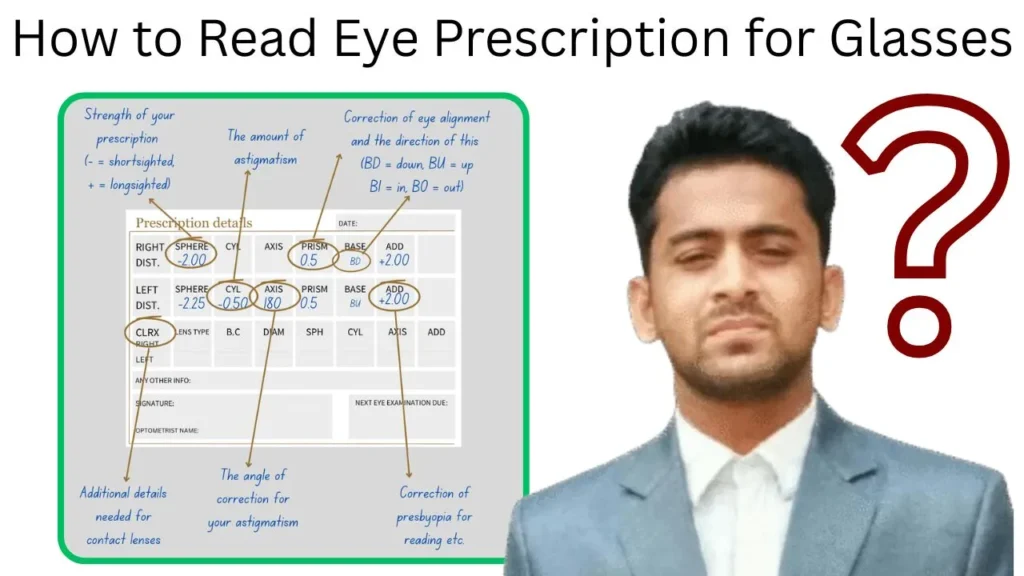
| SPH | Sphere | Lens power for near or far vision |
| CYL | Cylinder | Astigmatism correction |
| AXIS | Axis | Direction of astigmatism |
| ADD | Addition | Extra power for reading |
| PD | Pupillary Distance | Distance between pupils |
All these values instruct the optician on how to make the lenses of your glasses.
1. SPH (Sphere): The Power of the Main Lens.
The SPH value shows the power of the lens required to refract the vision.
It is measured in diopters (D).
The SPH values are of two kinds:
Negative (-) Sphere
I have a minus sign (-) to indicate that you are short-sighted (myopia).
People with myopia:
- Can see near objects clearly
- Poor vision of objects which are away.
Example:
- SPH -2.50
This implies an average shortsightedness.
Positive (+) Sphere
The farsightedness (hyperopia) is represented with the plus sign.
People with hyperopia:
- See distant objects clearly
- Have difficulty focusing on nearby objects
Example:
- SPH +1.75
2. CYL (Cylinder): Astigmatism Correction
The astigmatism is measured by the CYL value.
Astigmatism is a problem with the cornea that has an irregular corneal shape, thus making vision blurred or distorted.
In case the CYL column is blank or appears as 0.00, then that indicates no astigmatism.
Example:
CYL -1.25
This is showing mild to moderate astigmatism.
Symptoms of astigmatism common symptoms are:
- Blurred vision
- Eye strain
- Headaches
- Difficulty seeing at night
3. AXIS: Direction of Astigmatism
Axis value The Axis value indicates the direction of astigmatism in the eye.
axis values are from zero up to 180 degrees.
Example:
AXIS 90
or
AXIS 180
The axis value is in collaboration with the CYL value. In case of a lack of cylinder power, the axis is normally blank.
4. ADD (Addition): Reading Power
ADD value is the reading glasses or progressive glasses.
It is the extra magnification that one needs to see the things near to him.
Example:
ADD +2.00
This is to say reading part of your glasses will be an additional 2.00 of power.
ADD is typically used when a person develops presbyopia, a complication that develops past 40 years old.
Studies also indicated that such things as presbyopia have the following symptoms:
- Problem with reading small text.
- Holding books far away
- Eye fatigue during reading
5. PD (Pupillary Distance)
PD is an abbreviation suggesting Pupillary Distance.
It is a distance between the centers of your pupils, typically the distance is in millimeters.
Example:
PD = 62 mm
The significance of PD is that it makes sure that the optical center of the lenses fits into your eyes.
Incorrect PD can cause:
- Eye strain
- Blurry vision
- Headaches
Example of an Eye Prescription Explained
An illustration of a common prescription is here.
| Eye | SPH | CYL | AXIS | ADD |
| OD | -2.00 | -1.00 | 180 | +1.50 |
| OS | -1.75 | -0.50 | 170 | +1.50 |
Explanation:
Right Eye (OD)
- Nearsightedness: -2.00
- Astigmatism: -1.00
- Axis: 180
Left Eye (OS)
- Nearsightedness: -1.75
- Mild astigmatism: -0.50
- Axis: 170
ADD +1.50 indicates that the individual requires reading aid.
Types of Glasses Based on Prescription
Doctors may prescribe the various kinds of lenses depending on your prescription of the eye.
Single Vision Lenses
Applied in correcting one of the types of vision impairments, which includes:
- Nearsightedness
- Farsightedness
Bifocal Lenses
Contain two lens powers:
- Distance vision
- Reading vision
Progressive Lenses
Progressive lenses have three directions of clarity:
- Distance
- Intermediate (computer use)
- Near vision
These glasses do not have an explicit line as the bifocals do.
Tips for Understanding Your Eye Prescription
The following are just some of the things to keep in mind:
Negative (-) is short sighted.
plus number is + which means farsighted.
Astigmatism is manifested in the cylinder value.
Axis exhibits the sterigmatism direction.
ADD means reading power
One can never change glasses prescription without consulting their eye doctor or optician.
When Should You Get an Eye Test?
The eye professionals advise eye examination:
- Every 1–2 years
- In case you have blurred vision.
- Frequent headaches
- Difficulty reading
- Eye strain from screens
Periodical eye checkups are useful in the identification of such issues as:
- Myopia
- Hyperopia
- Astigmatism
- Presbyopia
Conclusion
It might seem difficult to read an eye prescription in the beginning but once you are familiar with such terminologies as SPH, CYL, Axis, ADD, and PD, there is nothing to worry about.
These figures assist eye doctors by making them know the precise power of the lens required in order to correct your vision. When ordering a pair of glasses online, also knowing how to read your prescription can help you to select right glasses.
When you observe any visual or headache changes or eyestrains, make an eye appointment to be adequate in your prescription.
Vision is imperative in day-to-day life thus vision should not be overlooked.

Hello everyone, I am Md Habibullah Sheikh a registered Pharmacist in India with 6 years of experience in Clinical, Community, and corporate pharmacy.
I have worked for HLFPPT, Gauripur Hospital, Reliance Retail Pharma (Netmeds) and Zota Health Care as a Senior Pharmacist.
Currently I am running a blog site called - healtheasyfitness.com and Youtube channel called Pharmacist - Habibul
We, In Health Easy Fitness, share trustable health education, tips & awareness to help people find the best health choice.
Always talk to a doctor before taking any kind of Health issue Decision.